Septarium
Septaria are approximately spherical concretions (irregular, often rounded mineral aggregates), usually with a diameter of 8 to 90 cm. They generally consist of impure, clay-rich carbonate, such as clay ironstone. Their interiors are traversed by desiccation and/or shrinkage cracks.
These cracks are filled with crystalline minerals, most commonly calcite, but also siderite, pyrite, barite or quartz.
The formation of a septarium probably proceeds as follows:
A concretion forms in soft sediment, often around organic material.
As the sediment compacts or dries, the concretion shrinks and develops cracks.
Mineral-rich fluids flow into the cracks and crystallize.
Over time, erosion exposes the nodule.
Origin of name: from Latin saeptum, meaning enclosure, fence, or partition.
Synonyms and trade names: occasionally used trade names include dragon stone, beetle stone or turtle stone.
Locations: worldwide, mostly in carbonate-rich clay shales. Some of the most vividly colored septaria come from Muddy Creek, Orderville, Kane County, Utah, USA.
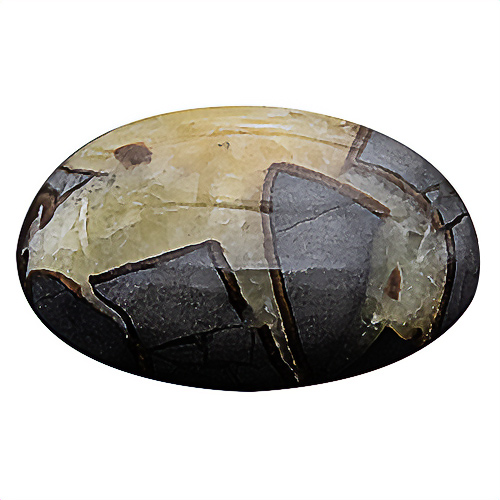
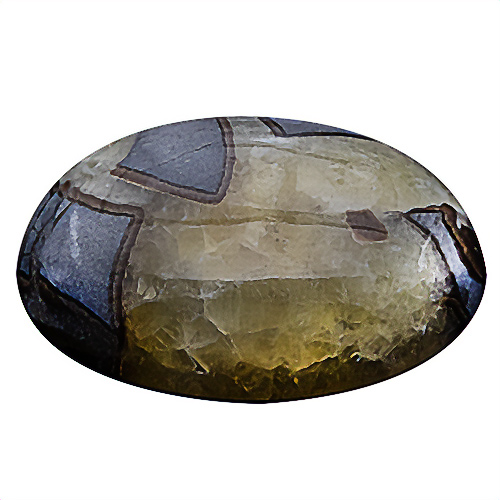
Septarium from Utah
Other well-known occurrences are found in France, England, Poland, Germany, Madagascar, Australia, and New Zealand.
 Deutsch