Treatments applied to gemstones
beryllium-treated
Gemstones which have been subjected to a high-temperature treatment with beryllium as an additive. Mainly golden yellow, orange, pink and red as well as the treasured padparaja colours are produced by beryllium treatment.
Reportedly the process was accidentally discovered in 2001 by a Thai gemstone treater who first "cooked" chrysoberyls and then a small lot of sapphires from Songea, Tanzania.
After the first treatment a chrysoberyl got jammed in the claystones of the fire chamber, which went unnoticed at first. The subsequent heat treatment of off-coloured Songea sapphires produced spectacular padparaja colours which soon caused some commotion on the local markets.
Without knowing the cause for his success, the good man started treating every Songea sapphire he could put his hands on and probably made a small fortune.
Only when after dismantling and servicing the furnace the previous results could not be reproduced any longer, the guy started to investigate and eventually found the solution.
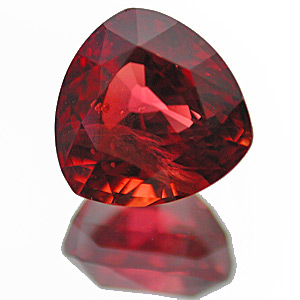
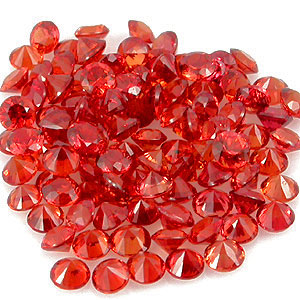
typical colours of be-treated sapphires
The first beryllium-treated stones had the problem of the new colour penetrating only a very thin layer below the surface. Thus these stones could not be recut without at the same time grinding off the coloured layer.
However, the depth of penetration of the beryllium ions is proportional to the duration of the process. The longer you heat the stones, the deeper the colour penetrates.
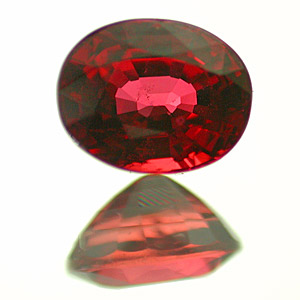
Today gems are heated until the beryllium penetrates the whole, or at least almost the whole stone. Sometimes a small core of the original colour is deliberately left. For instance a remaining pink core gives the resulting red colour a very nice and vivid tone:
The Gemmological Institute of America (GIA) and other authoritative bodies of the gem industry agreed to term beryllium-treated gems "diffusion treated".
We (and many others) are not 100% happy with this, for the following reason:
with the term "diffusion treated" one usually associates blue sapphires and, much rarer, rubies that have undergone another high temperature treatment in which colouring agents (chromophores) diffuse into the gem from the outside.
Now, of course, this is also the case with beryllium treatments but there is one fundamental difference, depth of colour penetration.
Old-style diffusion treatment of blue sapphires and rubies produces a very thin layer of colour which on average measures a mere two to four tenths of a millimeter. Should one ever attempt to re-polish or even re-cut such a stone, the colour will be grinded off.
clarity enhanced
Gemstones are termed "clarity enhanced" if they have been submitted to a treatment to improve their clarity by introducing a colourless substance such as oil, wax, natural or synthetic resin (polymere) or any colourless substance other than glass into fissures and cavities. Gems whose fissures have been filled with glass or a glassy substance are termed "glass filled".
The aim of such a treatment is the reduction or, ideally, the elimination of reflexions of light from fissures present in the host material by the introduction of a colourless agent whose refractive index matches that of the host material as closely as possible. If the refractive indices of host material and filler agent match exactly, fissures will be rendered invisible.
Clarity enhancement by filling fissures with colourless substances is a legitimate treatment which is accepted by CIBJO (Confédération Internationale de la Bijouterie, Joaillerie, Orfèvrerie, des Diamantes, Perles et Pierres, Engl. short: The World Jewellery Federation) and which does not require specific information of the modifications applied. However, general information about the stone being clarity enhanced has to be given at the point of sale.
Emeralds most frequently undergo a clarity enhancement by filling fissures with a colourless substance because highly clean or even eyeclean emeralds are extremely rare and very expensive, indeed. By clarity enhancing emeralds with clearly visible fissures, gems of apparently good clarity can be marketed at affordable prices.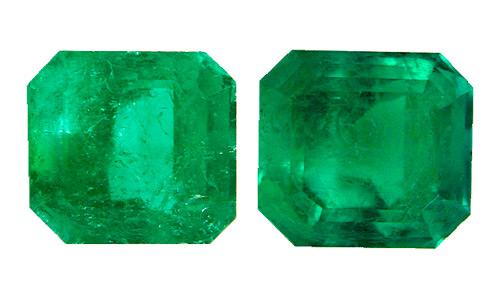
The photo shows one and the same emerald before and after treatment
Attention: since most emeralds have been subjected to clarity enhancement, it is highly recommended to observe a few precautionary measures.
Never clean emeralds in ultrasonic devices.
Do not bring emeralds into contact with alcohol or brine (detergent) as this could pull out the filling agent.
coated
Some gems, in particular topaz and quartz, are colour coated using various treatments like physical (PVD) or chemical vapour deposition (CVD).
With these treatments layers of metal are deposited on the stones surface, commonly titanium or gold. The colours thus produced are pink and red, green and petrol blue/green. One type of PVD or CVD treated topaz shows iridescence in all colours of the rainbow and is marketed as "mystic topaz", "aurora topaz" or the like.
Experience shows that the coloured layer can very easily be removed. Even handling such stones with tweezers may suffice to produce scratches. Due to the thinness of the coating, usually only 1-4 micron, these stones cannot be re-polished.
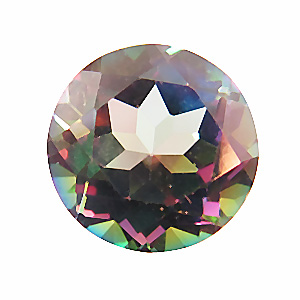
Mystic topaz
As a matter of principle the Vienna Gem Center does not deal in coated gems
diffusion treated
Diffusion treatment is mainly performed on blue sapphires and, much rarer, rubies in order to intensify the colour of very pale or nearly colourless stones.
The procedure is a high temperature treatment with additives of colouring agents e.g titanium in sapphire and chromium in ruby. During the process these "chromophores" diffuse into the stone from the outside to produce a deep colour.
The problem with this treatment is that the effect is very superficial, indeed. The average depth of the coloured layer thus produced is a mere 2-4 tenths of a millimeter. This means that if the stone should ever be repolished or recut, the colour will be grinded off.
We of the Vienna Gem Center think this kind of treatment constitutes a violation of the ethics of the trade, even if disclosed at the point of sale. we do not sell such stones.
Detection:
The colour concentrates at facet edges where it can penetrate from two sides.
Immersion in highly refractive liquids like methylene iodide (cooking oil will do nicely, too) reveals a spiderweb-like appearance.
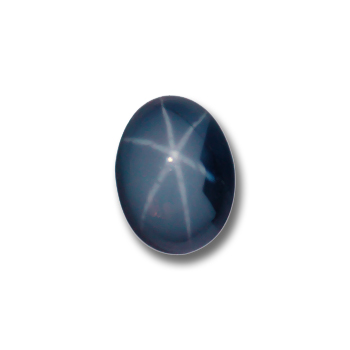
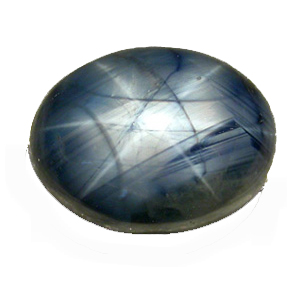
Also to be found on the market are synthetic star rubies and star sapphires in which star as well as colour have been artificially induced by a diffusion treatment. These stones are characterized by razor-sharp stars and unnaturally even colour distribution.
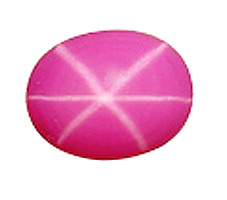
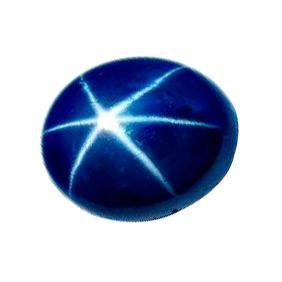
Synthetic star ruby and synthetic star sapphire
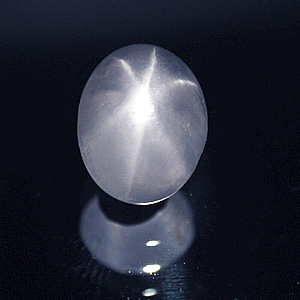
Natural star sapphire from Sri Lanka
dyed
Some gem materials, e.g. quartzes like carnelian and onyx, do not occur naturally in large enough quantities to fulfill the demand. so other quartzes of lighter colour are dyed to the desired hue.
Some materials, e.g. mother of pearl, are dyed in colours not occurring naturally
The treatment is permanent and irreversible.
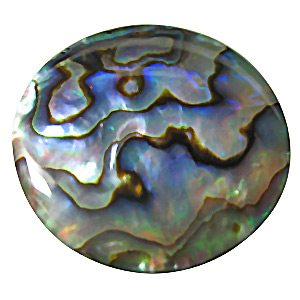
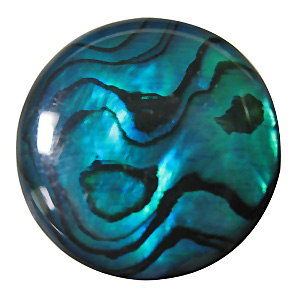
Natural paua shell Dyed paua shell
etched
Untreated pieces of iron meteorite resemble slag. only after sawing and a subsequent acid treatment, the marvellous widmannstaetten patterns appear, which, by the way, cannot be reproduced by man and thus give prove of the natural origin of the meteorite.
See also: http://en.wikipedia.org/wiki/Gibeon_(meteorite)
glass-filled
Gemstones which have been clarity-enhanced by the filling of fissures with glass or glassy substances.
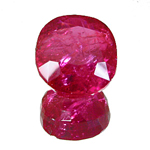
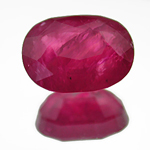
The procedure is accepted by the CIBJO (Confédération Internationale de la Bijouterie, Joaillerie, Orfèvrerie, des Diamantes, Perles et Pierres engl. short The World Jewellery Federation). Stones having undergone clarity enhancement by the filling of fissures with glass or glassy substances must be declared as such.
Currently this procedure is mainly conducted with african rubies.
We of the Vienna Gem center consider the practice to be non-ethical and a violation of the gemtrades code of conduct, even if disclosed at the point of sale.
The problem is that the filler materials are highly susceptible to acids and solvents. The goldsmith´s pickling solution and even quite mild acids like lemon juice suffice to damage the glass filler and thoroughly alter the visual appearance of the ruby.
Since October 3rd, 2011 GRS and AGL laboratory reports read as follows:
GRS
Synthetic* Glass/Treated Ruby (GRS-type “Hybrid Ruby”)
Comments: Heat-treated and filled with a colored foreign solid substance (including lead). Special care required when handling. Also known as Composite Ruby.
*note: the term "synthetic" may be misleading. In our opinion it refers to the man-made nature of the glass rather than the ruby, which is of natural origin
AGL
Composite Ruby
Comments: This stone is a composite of natural ruby and a high lead content glass. Also known as Hybrid Ruby.*
*See Enhancements section of the AGL report for additional comments related to the durability and special care of this product.
On principle the Vienna Gem Center does not trade in glass-filled gems.
glued
Gemstones may be glued for various reasons.
If a layer of opal is too thin to cut a full stone but too beautiful to be wasted, a wafer-thin layer of opal is glued onto a base of glass, plastic or onyx. The result is called an opal doublet.
If on top of that another layer of e.g. glass or rock crystal is glued, it´s called a triplet

Opal triplet
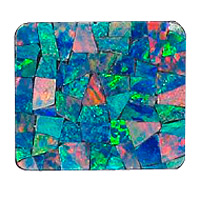
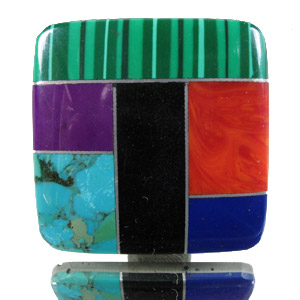
Bad guys sometimes glue the genuine upper part of a gemstone onto a pavilion of glass or synthetic gem material to feign a more expensive colour or the doublets´ genuineness altogether.
The contact layer of the two parts can be seen along the girdle. If the girdle is hidden by a closed setting, these doublets can be hard to detect.
heat treated
Gemstones which have been subjected to thermal treatment to improve their colour.
Heat treatment of gems is a legitimate treatment which is accepted by CIBJO (Confédération Internationale de la Bijouterie, Joaillerie, Orfèvrerie, des Diamantes, Perles et Pierres, Engl. short The World Jewellery Federation) and which does not require specific information of the modifications applied. However, general information about the stone being heat-treated to enhance it´s colour has to be given at the point of sale.
The art of "cooking" gemstones is almost as ancient as the gemtrade itself. the earliest known reference is found in pliny´s (23-79 AD) monumental work historia naturalis.
During a simple heat treatment no colour is added to the stone from the outside.
In fact during the process only colour, which is potentially present in the gem already, is developed.
Explanation using the example of blue sapphire:
The colouring elements (chromophores) of blue sapphire are titanium and iron ions (the latter producing an undesirable greenish tinge).
a very common inclusion in sapphire is rutile, a titanium mineral with the chemical formula TiO2.
The melting point of titanium is 1656°C, that of sapphire is 2053°C.
When a sapphire is heated to temperatures above the melting point of titanium, titanium ions diffuse from the rutile inclusions into the surrounding host crystal and there produce/intensify the much cherished blue colour.
In other words, if mother nature had heated the sapphire sufficiently (once more) during it´s growth, exactly the same thing would have happened.
At the same time rutile needles disintegrate and thus clarity is usually also improved somewhat after heat treatment
How can i detect heat treatment?
Most gemstone inclusions have lower melting points than their hosts.
Thus most inclusions melt and change in shape during the process. Rutile needles will become rutile grains or even dust and beautifully crystallized mineral inclusions will melt down to snowball-like spheres.
Simultaneously so-called stress halos appear around the (molten) crystal because most "guest crystals" have higher expansion coefficients than their hosts.
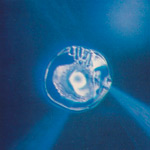
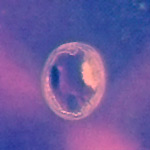
Stress halos surrounding molten crystals bear
testimony to heat treatment
Attention: many inclusion minerals produce stress halos without heat treatment
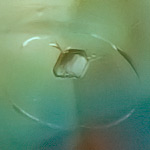
This beautifully crystallized zircon inclusion with stress halo proves that the host sapphire has not been heat treated!
Colours produced by thermal treatment are stable i.e. do not bleach under UV light.
The change of colour affects the whole stone and not, as in diffusion treated stones, only a few tenths of a millimeter below the surface.
Gems that have been heat treated only, can safely be re-polished to remove signs of wear or recut to fit a slightly smaller setting. As long as you do not remove too much during recutting, colour will be unaffected.
imitation stone
Artificial product without natural counterpart.
Cubic zirconia (not zircon, mind you!) is a man-made diamond imitation. There are no naturally occurring cubic zirconia.
irradiated
Some gemstones, mainly topazes are irradiated by gamma rays, neutrons or electrons in order to induce or improve colour.
The first colour which was produced in topaz by irradiation was called london blue, a deep, very slightly greenish (petrol) blue.
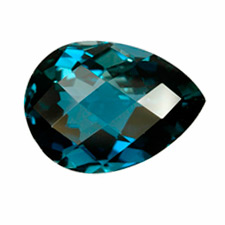
London blue
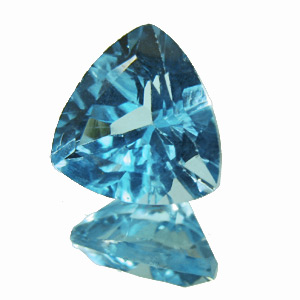
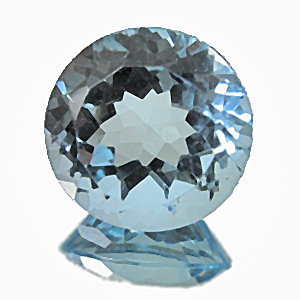
After treatment the irradiated gems have to "cool" for several months to allow any residual irradiation to wear off below permitted levels. the length of the cooling period depends on the method of treatment.
We of the Vienna Gem Center purchase irradiated topazes only from highly reputed producers who, due to their enormous stock, can afford to let the stones cool off way beyond the required time.
To dispel all doubts we store our topazes for another three months (minimum!) before we release them. By far the most of our topazes have been with us for several years!
FAQ:
Is it dangerous to wear blue topaz?
No! Read what the NRC (United States Nuclear Regulatory Commission) has to say:
The NRC has no indication that wearing irradiated gemstones can be harmful. There have been no reported cases of anyone being harmed by wearing irradiated gemstones.
Furthermore:
From a safety standpoint, there is no reason to stop wearing blue topaz or any other irradiated gemstone.
And finally:
A study done by the NRC estimated that a person wearing a blue topaz stone at the highest level of radioactivity allowed for distribution under NRC regulations would receive an annual dose of 0.03 millirem (NUREG 1717, page 2-21). By contrast, a chest X-ray is about 60 millirem.
no indications
The colour of some gem stones like beryl (in particular aquamarine), tourmaline e.a. can be greatly improved by low-temperature treatments.
Thus it is possible to remove unwanted green tones in many aquamarines or lighten the colours of too dark tourmalines.
The change of colour is permanent and effects the whole stone as opposed to diffusion treatments, which affect only a very thin surface layer.
This is important, should the need for recutting or repolishing arise.
The treatment is performed at rather low temperature of several hundred degrees Celcius (corundum is treated at up to 1.900°C!) and generally does not alter inclusions.
Mostly low temperature treatments are not detectable, at least not with standard gemmological methods available to (even well equipped) labs.
polished
This material has been polished only.
No other treatments were applied.
smoked
Hydrophanous Ethiopian opal can be turned black by prolonged exposure to smoke. The treatment is stable and irreversible
surface hardened w. resin
To render relatively soft minerals like e.g. chrysocolla more durable, they are sometimes treated with synthetic resins.
Turquoise and other porous gem materials are frequently resin-treated to keep substances like oil, perfume, detergent or sweat from spoiling their colours.
synthetic
Artificial products having essentially the same chemical composition, physical properties and crystal structure as those of their natural counterparts.
untreated
Only materials which have been formed completely by nature, without any human interference, and which have subsequently been modified only by means of cutting and polishing, may be called "untreated"
waxed
Some gemstones, for example turquoise, have porous surfaces.
To avoid substances like oil, perfume, detergent or sweat to stain the colour, these stones were wax-impregnated.
Nowadays much more durable (synthetic) resins have replaced the wax.
 Deutsch