Ruby
Red variety of the mineral Corundum.
Ruby shop
Origin of name: from Latin ruber, red
Synonyms and trade names: none. However, there is a plethora of misleading names for other red gems, mostly garnets, which contain the word "ruby", intending to ennoble the name bearer.
Some examples:
Adelaide Ruby: Almandine Garnet from Adelaide, Australia
American Ruby: Pyrope Garnet or Rose Quartz
Arizona Ruby: Pyrope Garnet from Arizona, USA
Balas Ruby: an old name for red Spinel
Bohemian Ruby: Pyrope Garnet from the Czech Republic
Cape Ruby: Pyrope from the Cape Province, South Africa
Colorado Ruby: Pyrope Garnet
Mont Blanc Ruby: Rose Quartz
San Diego Ruby: Rubellite (red Tourmaline) from San Diego, California
Siberian Ruby: Rubellite (red Tourmaline) from Russia
Can be confused with: numerous other red gems as well as with synthetics and glass.
Burma (Myanmar) and Vietnam produce red Spinel of fine Ruby colour.
Distinction from other natural gems is usually quite simple due to markedly different optical properties. Spinels and Garnets are singly refractive and the birefringence of Tourmaline is much stronger than that of Corundum.
Distinction from synthetics:
In general the detection of Verneuil synthetics is no big challenge for the experts.
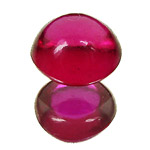
Unusual Synthetic Verneuil Cabochon
Normally synthetics are facetted
Other synthetics, which are produced by more sophisticated and expensive methods, can pose serious problems, though. Careful microscopic studies of inclusions mostly lead to successful identification, where loupe and experience do not suffice. In very rare cases advanced technology like element analysis by e.g. x-ray diffraction or Raman-Spectroscopy has to step in.
The good news: the danger to fall for a high-end synthetic ruby (or sapphire) has diminished significantly over the last years. Due to enormous production costs and probably also due to unsatisfying economic success, several companies have stopped production or closed down altogether.
"Geneva Ruby", the first synthetic gemstone
Because of the high value Rubies are amongst the gems that are synthesized and imitated most often. The earliest synthetic gems known were the so-called "Geneva Rubies" which were produced as early as 1885 and sold as genuine by a Geneva dealer.
In 1886 Paris jewellers gave the Sorbonne University some Geneva Rubies for examination. A Professor Friedel found them to possess the same density, hardness and optical properties as natural rubies. However, under magnification Friedel found numerous gas bubbles typical for glass and rightly concluded that the rubies were produced by some kind of high-temperature fusion process. Another tell-tale characteristic are very strongly curved growth lines.
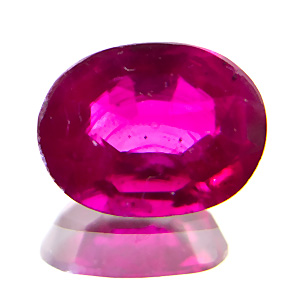
After it was decreed that these rubies were not to be sold as natural, claims were made that the stones were indeed produced by a flame-fusion process but that the starting material was fragments that were left over during the cutting of natural rubies.
For the next twenty years Geneva Rubies were being sold as "Reconstructed Rubies" at prices of $25 to $40 p.ct. until they were finally pushed off-market by the far superior Verneuil synthetics in 1904.
Where and by whom Geneva Rubies were produced has never been found out. In his benchmark book "Gems Made by Man", published 1980, Dr. Kurt Nassau proved that Geneva Rubies were produced by a three-step-process, which can be regarded as a forerunner of the Verneuil process.
Localities: most famous are the ruby pits around Mogok, Burma (today: Myanmar)
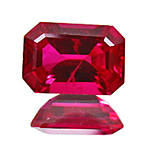
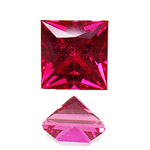
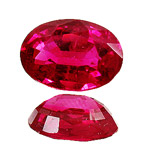
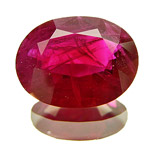
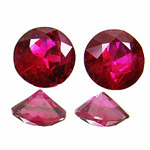
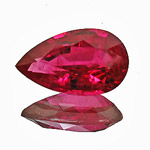
Some Burma Rubies of fine quality
Another important source is Vietnam. Because of the very similar geology, Vietnamese Rubies are very hard to distinguish from Burma Rubies, at least at first sight. However, due to increasing fraud with synthetic rubies, many traders from Thailand, were most of the world's Rubies are cut and traded, retired from the Vietnam Ruby business so that today Vietnamese Rubies do not play a major role on the market.
Sri Lanka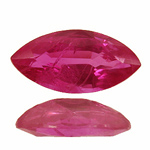
"Ceylon" Ruby
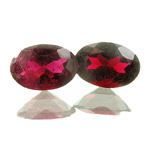
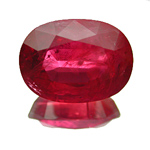
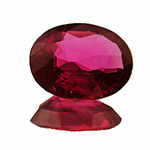
Thai Rubies in different shades of red
The center stone weighs 20.85cts!
On the African continent, by far the most important source of Ruby lies in the north of Mozambique, in Cabo Delgade province.
In daylight some of the material found there does look a bit "sleepy". In incandescent light, however, many outshine the famed Burma Rubies. Whereas the latter often have a distinct pinkish tinge, Rubies from the new source show a deep, pure red.
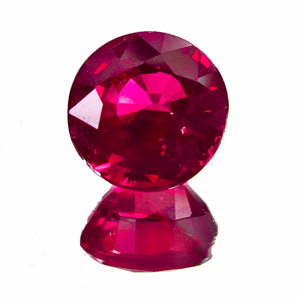
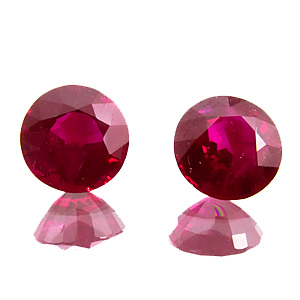
The best Rubies from Cabo Delgado province show a fine red in any light, many of them even without heat-treatment.
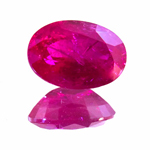
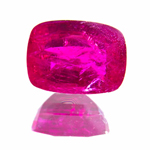
Untreated Rubies from Mozambique
Besides the Mozambique mines, there are a number of other Ruby locations in Africa.
Unfortunately only a few of them occassionally produce fine quality gems.
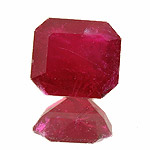
Untreated Tanzanian ruby
Mined in 1987
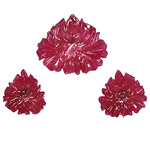
Three leaves, hand-carved in India from African rough material
Without a doubt the most spectacular African Rubies came from a source discovered near the Tanzanian village of Winza in 2007. The colour of these Rubies needed no improvement but unfortunately it seems that all hopes for prolonged and sustained production have dwindled. According to our knowledge of summer 2010, the Winza mines are no longer productive.
Malawi occasionally produces fine quality Rubies but not enough to play a significant role in the world's Ruby trade.
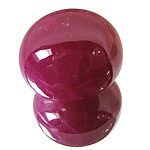
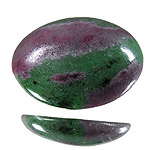
Kenya also produces large quantities of a green, red and black mixture of Ruby, Zoisite and Amphibole which occasionally is made into cabochons. More often, however, the material is carved into small figurines.
Quality criteria:
With most gemstones
Cut
is of primary importance. A perfect cut can turn a rather pale piece of rough into a sparkling jewel. On the other, the best rough can be spoiled by bad cutting.
With Rubies one is much more tolerant. Even flat stones that hardly show any brilliance will be accepted if only the colour is good enough.
Which takes us to the most important C of Ruby
Colour
Not so with Ruby. The famed pigeon blood red, which is a red as pure and vivid as possible, has been the most desired and most expensive colour for centuries. Any pinkish or, worse, brownish tinge is punished by a decrease of value.
Clarity
The importance of clarity is about the same as that of cut. As long as the colour is good enough inclusions are tolerated. More so, in fact, than in most other gemstones with the exception of Emerald.
Of course the price per carat decreases along with clarity but in contrast to, say, sapphire, even milky rubies will eventually find a buyer.
Size
is of much higher importance than with most other gems. There is hardly another gem stone whose value rises as dramatically with size as Ruby. In contrast to most other gems, 2cts is already considered quite large. The 8.62 carat record holder mentioned below (see: Worth knowing) would probably not have fetched more than $5000 if it were a 1ct stone…
Thermal treatment
By heat-treating Rubies many undesired bluish or brownish tinges can be reduced or sometimes made to disappear altogether.
Glassfilled Ruby: the market is being flooded with glasfilled "Rubies". The source material is very low grade ruby, mostly from Madagascar. The surface-reaching fissures of this rough are filled with lead-glass which improves transparency dramatically.
Of course this treatment must be disclosed at the point of sale but unfortunately this regulation often either ignored completely disclosure is insufficient. Merely describing a glass-filled Ruby as "treated" is misleading and, in our view, bordering to fraudulent.
Attention: we can only warn you to buy such "Rubies", however temptingly cheap they may be. Many of these stones contain more glass - up to 70% ! - than Ruby. So, actually in these cases one should speak of glass with ruby content. Indeed, some international laboratories call such stones "composite material".
Furthermore the fillings can be quite short-lived. It has been found that plain lemon juice suffices to etch the lead-glass...
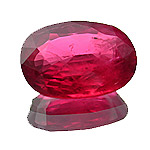
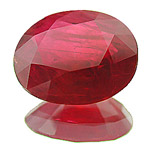
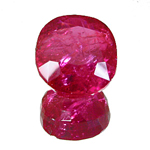
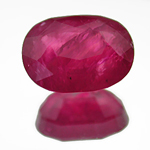
Some glassfilled Rubies weighing up to 8cts
Handling: rubies can be heat-sensitive. High temperatures can cause a colour change. Most Corundums have mineral and liquid inclusions. These have higher expansion coefficients than their host. Thus they expand more upon heating which can produce cracks or even total destruction.
Sensitive to salts and brines. No borax!
Worth Knowing: Ruby is the undisputed king of coloured gemstones, at least when it comes to value. In February 2006 Christie's scored a whopping 425.000 dollars per carat for a 8.62cts Burma Ruby thus shattering the old record of "merely" $275.000 per carat, paid for another 8ct Burma Ruby in the year before.
Ruby shop
 Deutsch