Pink Sapphire
Pink variety of the mineral Corundum.
Pink Sapphire shop
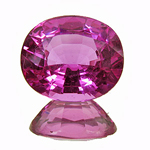
A top quality pink Sapphire from Madagascar
The border between pink Sapphire and Ruby is not defined which was the cause of heated debates in the past. The gem trade tended to refer to intensely coloured pink Sapphires as Rubies to justify higher prices.
Today this debate is obsolete because by and by pink Sapphire has gained immensely in popularity, as well as in value. We of the Vienna Gem Center always held the opinion, that it is much better to own a pink Sapphire of truly excellent colour, rather than a Ruby of questionable i.e. very light colour.
Origin of name: from Greek σάπφειρος sappheiros, which derives from Hebrew ספיר cappiyr. This term described blue gemstones like Sapphire, Lapis Lazuli and probably many more.
Synonyms and trade names: none
Can be confused with: almost all other transparent pink gems, synthetics and glass.
The number of gems occurring in pink colour is rather large. Most important are Tourmaline, Spinel, Beryl (Morganite), Topaz, Spodumene (Kunzite) and Diamond. Some Garnets, in particular Rhodolite Garnet, also occur in pink colour.
Identification is achieved via optical and physical properties like refractive index, birefringence (double refraction), specific gravity (density) and absorption spectra.
Usually the identification of (pink) Sapphire poses no big problem to gemmologists.
Identification of synthetic pink Sapphire:
The synthetic Sapphires encountered most frequently in the trade are so-called Verneuil Sapphires. The process was patented in 1902 and mass production started as early as 1904. Thus the fact that a Sapphire has been family-owned for a century is no proof of natural origin!
In general the detection of Verneuil synthetics is no big challenge for the experts. Other than Verneuil Rubies, almost all Verneuil Sapphires show tell-tale gas bubbles and curved striae.
Other synthetics, which are produced by more sophisticated and expensive methods, can pose serious problems, though. Careful microscopic studies of inclusions mostly lead to successful identification, where loupe and experience do not suffice. In very rare cases advanced technology like element analysis by e.g. x-ray diffraction or Raman-Spectroscopy has to step in.
The good news: most synthetic pinks are cheap Verneuil stones. High quality pink Sapphire synthetics are much rarer than Synthetic Rubies. Besides, the danger to fall for a high-end synthetic Sapphire (or Ruby) has diminished significantly over the last years. Due to enormous production costs and probably also due to unsatisfying economic success, several companies have stopped production or closed down altogether.
Localities: the most important deposits of pink Sapphire are to be found in Africa (Tanzania, Madagascar, Malawi) and in Asia (Sri Lanka, Burma, Vietnam).
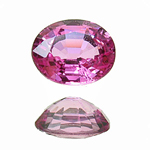
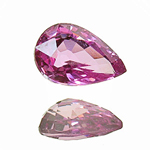
Handling: due to the great hardness and the absence of cleavage Sapphire generally is easy to work with.
However, Sapphires can be heat-sensitive. High temperatures can cause a colour change.
Most Corundums have mineral and liquid inclusions. These have higher expansion coefficients than their host. Thus they expand more upon heating which can produce cracks or even total destruction.
Sensitive to salts and brines. No borax!
Pink Sapphire shop
 Deutsch