Chrysocolla
Attractive copper silicate mineral commonly associated with other copper minerals.
Chrysocolla shop
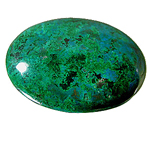
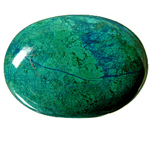
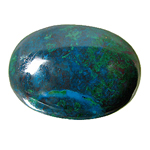
In rare cases translucent to opaque acicular, orthorhombic crystals are found. Mostly, however, chrysocolla occurs as cryptocrystalline to amorphous, botryoidal aggregates.
Origin of name: from greek chrysos, Gold, and kolla, glue, because it was allegedly used as a soldering agent in antiquity. The name was first used by the Greek philosopher and natural scientist Theophrastos.
Synonyms and trade names: the most common trade names are eilat Stone and eilatite, denoting intergrowths of chrysocolla and turquoise or malachite occurring north of the city of Eilat, Israel, at the Gulf of Aqaba.
Intergrowths with quartz are termed chrysocolla quartz.
Other, seldomly used synonyms are beaumontite, bisbeeite, dillenbergite and copper pitchblende.
Can be confused with: turquoise, malachite, azurmalachite (intergrowths of azurite and malachite) and variscite.
Localities: very common. Mindat.org lists more than 2.900 deposits.
Commercially important localities are Israel (Eilat) and the USA (Arizona, Nevada).
Other deposits of lesser importance are in Peru, Chile, Ecuador, the Ural Mountains and the copper mines of Katanga Province, Republic of Congo.
Handling: used in jewellery chrysocolla poses several major problems:
- chrysocolla is extremely heat-sensitive and must be unmounted before jewellery repair.
- chrysocolla is porous and very sensitive to all kinds of liquids. To protect its surface chrysocolla is often treated with synthetic resins. Nevertheless contact with e.g. perfume, body or suntan lotion, brine etc. must be avoided.
No Ultrasonic cleaning, no galvanic baths, no immersion in whatsoever!
- chrysocolla is brittle. Set with care and apply pressure gently. The brittleness combined with the resin treatment makes it almost impossible to recut.
Worth knowing: the term chrysocolla is often used for any massive, botryoidal, bluegreen aggregate. However, exact identification is not an easy task. For instance: the cryptocrystalline structure hardly ever produces a conclusive x-ray diffraction pattern.
Latest tests suggest that chrysocolla actually is a mixture of the mineral spertiniite (https://www.mindat.org/min-3724.html) and amorphous silica minerals like opal and/or chalcedony.
Chrysocolla shop
 Deutsch