Alexandrite
Colour changing variety of Chrysoberyl
Name: Named in honour of Czar Alexander II (1818-1881). First found on the day the (future) czar came of age.
Can be confused with: All other colour changing stones such as sapphire, garnet and spinel, synthetic alexandrite and colour changing synthetic corundum.
Localities: First found in 1830 near the Takovaya river north-east of the city of Ekaterinburg (Sverdlovsk) in the Ural mountains.
Other important sources are Brazil (Goiás, Bahia, Minas Gerais), Tanzania (Tunduru, Lake Manyara), Madagascar, India and Sri Lanka.
Zimbabwe produces well-grown crystals with good colour change which, however, are hardly ever cut due to their lack of clarity.
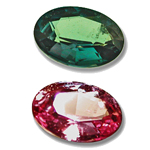
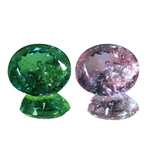
Alexandrite from Russia, left 0.20cts, right 10.50cts
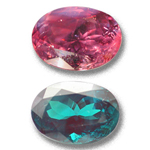
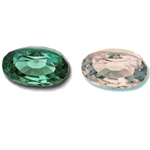
Alexandrite from India, left 2.50cts, right 0.75cts
The Indian sources are located in the federal states of Andhra Pradesh and orissa and were probably discovered at the beginning of the 21st century. Indian alexandrite is characterized by the very attractive bluish green daylight colour as well as the good clarity, which on average is better than in stones from other locations.
However, alexandrites from India need a certain size and weight, above one carat, to show intense colour and colour change. Unfortunately the mine is not very productive and stones above 3cts are exceedingly rare.
Handling: despite the hardness of 8.5 alexandrite is quite brittle. Due to the good cleavage it must be handled with care during setting. Do not clean ultrasonically! Sensitive to acids (boric acid) and heat. Unset before soldering!
Worth knowing: alexandrites of high clarity and good colour change are amongst the worlds rarest and most expensive gemstones.
There are synthetic alexandrites on the market, which are sometimes very difficult to identify. By far the most of the „synthetic alexandrites“ encountered are in fact synthetic (Verneuil) corundums, doted with vanadium to produce a colour change, which, however, differs greatly from the colour change of the real thing.
Still these stones are being offered to credulous tourists, not least in Egypt (Alexandria), as alexandrites. Even if disclosed as synthetics, which is hardly ever done, prices are mostly grossly inflated. Verneuil stones are mass produced and really worth only a few Euro per piece.
 Deutsch