Tagua - a success story
Since 1990, when the ban on trading ivory came into effect, vegetable ivory has celebrated a veritable comeback.
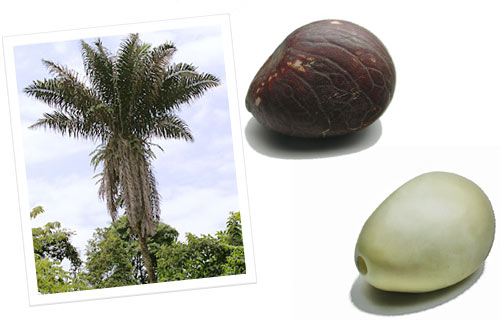
Female specimens of the Ivory-nut Palm, as it is commonly called, bear fruits reaching the size of a watermelon and weighing up to 10kgs. The fruits grow in clusters, so-called cabezas, containing 6 to 9 seeds each, which can be up to 15cms in length. The majority of these "nuts", however, measure 4 to 6 cm. In Ecuador, the main producing region, these nuts are called taguas, a name which quickly took hold in international trade.
Freshly harvested taguas contain a milky fluid, not unlike coconut milk and equally potable, and need to dry in the sun for several months. During that drying period the milky fluid solidifies and reaches its final hardness.
Below table illustrates how close the pyhsical data of vegetable and animal ivory are.
|
| Refractive Index | Mohs Hardness | Specific Gravity |
| Tagua-nut | approx. 1,54 | approx. 2 ½ | 1,40 – 1,43 |
| Ivory | approx. 1,54 | 2 ¼ - 2 ¾ | 1,70 – 1,90 |
After drying the taguas are released from their horned husk and now resemble animal ivory in structure and colour to a most astounding extent.
Taguas can be drilled, cut, carved and dyed and take a very high polish. The multi-purpose applicability along with stable supply and low prices (today a 4cm unpolished nut does not cost more than 2 to 5 Euro) made them a highly sought after commodity until the rise of even cheaper plastics. For the producing countries taguas were an important source of foreign exchange.
Taguas were made into jewellery, chess-men, billard balls, dice, buttons and much more. In the USA alone there were several factories producing tagua buttons. In fact in peak times 20% of all buttons produced in the United States were made of taguas. In the American civil war uniform buttons of the North (the Blue) were made of taguas, a fact much appreciated by snipers of the Confederate States of the south (the Gray) because the highly polished and well-reflecting buttons made first class targets.
With the rise of cheap plastics from the 1950ies on, demand for vegetable ivory quickly fell into insignificance. Since the ban on ivory trade came into effect in 1990 sales figures fortunately have been rising steadily. In the producing countries co-operatives were founded which support the local population in growing, processing and marketing. Tagua production has again become an important industry and economic foundation for a number of communities.
So, if you are a goldsmith planning some inlay job, your old piece of ivory has been used up and there is no camel bone at hand, why not use a tagua-nut?
 Deutsch